

Migratory Lepidopterans
More than just Monarch butterflies

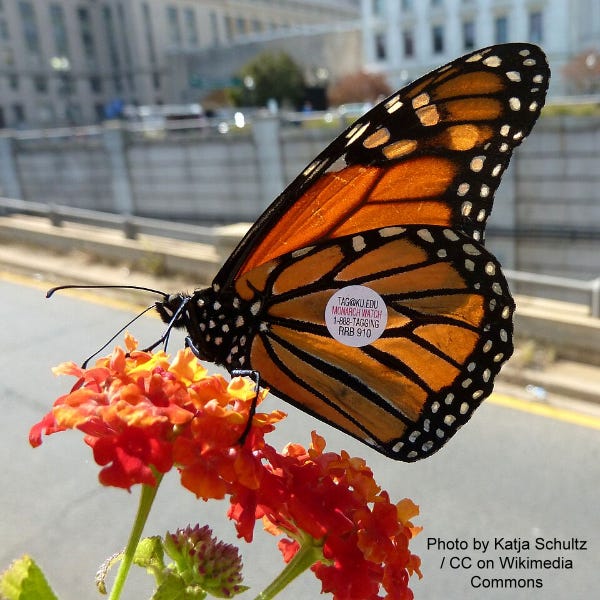
All the birds arriving here in Ontario the last couple of weeks has had me thinking about migration. I suspect pretty much everyone knows about the fantastic migration undertaken by Monarch butterflies. Their long flight south in the fall, to their overwintering grounds in Mexico, and then their generational return north in the spring. It’s not a great surprise that this has become so well-known - it is amazing to think an insect could cross such distances, and the giant winter colonies of beautiful, large butterflies spark the imagination.
But Monarchs are far from the only insect to undertake seasonal migration. In fact, they’re not even the only Lepidopteran. They’re just the most well-studied of our insect fauna - in part because of that concentrated winter population, which allows for mark-and-recapture projects to offer some level of feasibility.
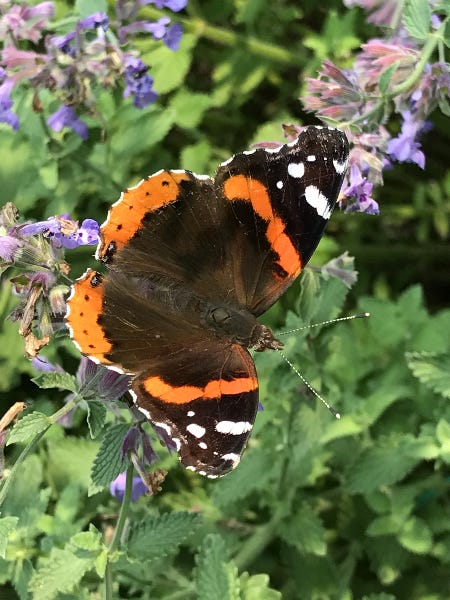
The three species of Vanessa butterflies, including Red Admiral, also head south in fall. They spend the winter spread across the southern US and Central America. Red Admirals reach Canada a lot earlier than Monarchs; I saw my first of the year a couple of weeks ago, but Monarchs won’t be here till mid- to late June, usually. Some dragonflies, such as the Green Darner, also migrate south in the fall to overwinter in the southern US.
What about moths? Well, it turns out it’s a lot harder to study migration in moths than it is in butterflies, not least because most of their movement - and indeed, their active presence generally - is nocturnal. In the fall, we can see Monarchs moving in a southerly direction, and watch them depart land over bodies of water like the Great Lakes, headed south. When moths leave, no one sees them go, or where they went.
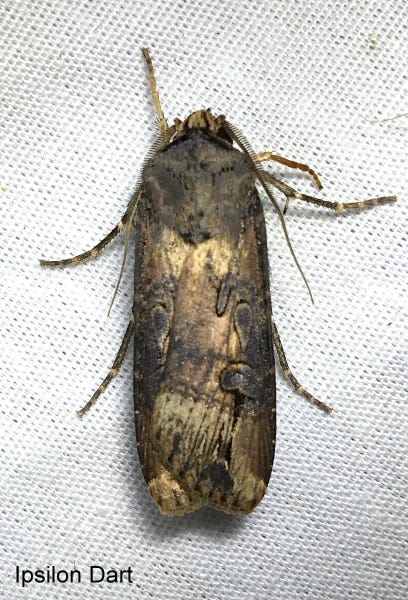
There are some moth species who migrate, though. One of North America’s most well-understood is Ipsilon Dart (Agrotis ipsilon). This is partly because it’s also found in Europe, where studies on migration have been made for longer than they have here in North America. The same is true for The White-speck (Mythimna unipuncta), often known in agricultural circles as Armyworm Moth.
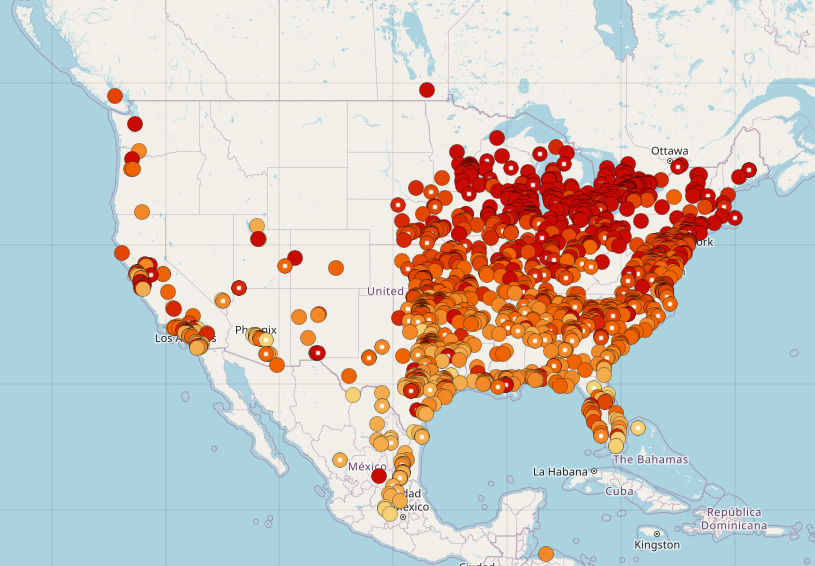
The evidence tends to be stronger for spring migration north than for a return fall migration south the way Monarchs do. We know that these species can’t survive the winter temperatures in the northern parts of their range, and yet they appear here every summer. We can also document migration fronts with datasets like iNaturalist, especially now that mothing has taken off in North America in the past couple of decades. A terrific example of this is this actively-updated “live” migration map for Monarch butterflies - first-of-year sightings are reported and mapped, creating a visual representation of the migration front moving north.
In recent decades, we’ve also been able to use stable isotope analysis to determine where individuals hatched. This is a really fascinating bit of science that I was first introduced to back when I was more involved with birds. It’s built on the fact that environmental atoms like carbon, nitrogen or hydrogen come in different “weights” (the number of tiny bits - neutrons - that make up their core), and these weights vary predictably by latitude and longitude. The atoms get incorporated into an animal’s tissues as they’re growing, taken from the food and air they ingest.
In a bird, you can sample a feather’s isotopes to see where the bird grew them (winter grounds for summer plumage, summer grounds for winter plumage). In a butterfly or moth, you can sample a bit of the wing or leg to determine where the insect spent its caterpillar stage, eating host plant atoms that were then incorporated into its body, which then became the adult winged form.
We know that quite a number of North American moth species will expand their populations north in the spring and summer, “recolonizing” areas where the species was killed off by winter conditions. Often these species are subject to population fluctuations in the northern parts of the range, depending on how far and where southern individuals travel. Some prominent examples of this are White-lined Sphinx (Hyles lineata), Ailanthus Webworm (Atteva aurea), Fall Armyworm (Spodoptera frugiperda), or Celery Looper (Anagrapha falcifera). But there are many others.
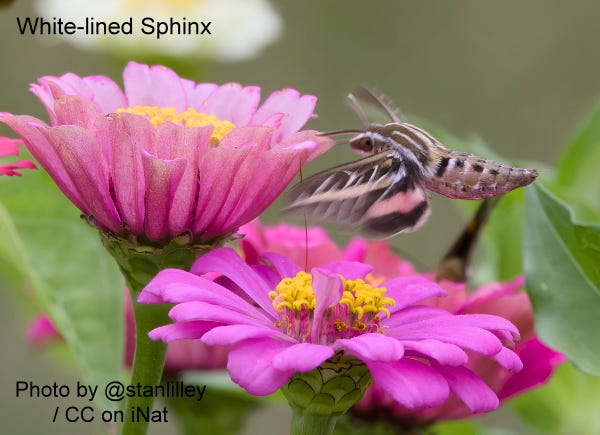
The extent to which these recolonizing species might also undertake a southward migration in the fall is unclear. What would the evolutionary benefit be to a species to expand northward only to have those progeny be killed off with the northern freezes? The behavioural gene mutation that encourages northward movement would be lost before it could confer any adaptive advantage, in terms of lineage longevity. Perhaps some of these species do also head south in the winter, and we just don’t have the documentation of that yet. Or perhaps the gene encourages exploration for new host plant populations but doesn’t necessarily dictate direction - and we only happen to notice the individuals whose wanderings carry them into previously unpopulated areas. (These are my own hypotheses, not something the scientific community has posited about these species.)
Southbound migration has been documented in a few species, though - notably the Ipsilon Dart and White-speck I mentioned earlier. Researchers have used sensitive radar apparatuses to detect the directional movement of insects, at altitudes outside of sight from our traditional means of observation (ie. eyeballs). Research for some of these studied species has shown that they’ll pick nights with favourable tailwinds to help them travel farther more quickly.
My favourite method of tracking these Lepidopteran migrants, though, is mark-and-release, as this is truly unequivocal. This was our first way of figuring out where birds traveled, long before any sophisticated technology started helping us follow their movements. We would capture the birds in migratory concentration points like peninsulas, put a lightweight metal band on their leg, and let them go. A very small number of these would be caught again at another banding operation hundreds or thousands of miles away, and we could draw a line between the two spots.
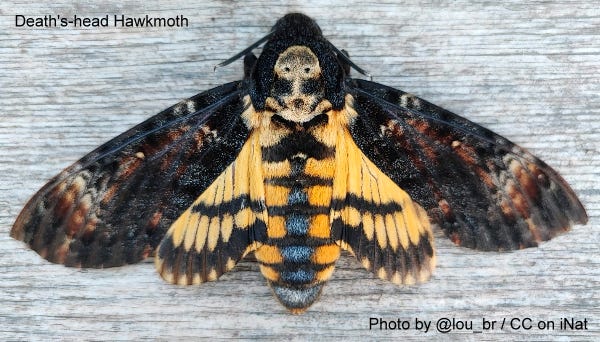
While bird banding still takes place today, technology has offered additional, more precise ways to track birds’ migration routes, such as radio transmitters and other types of geolocator tags placed on the birds. Amazingly, radio tracking has been used on insects, too. In Europe, researchers put tags on 14 Death’s-head Hawkmoths and followed them by airplane for up to four hours each session. One of these they managed to track along a straight line for a remarkable 90 km (56 miles). But the organisms carrying these tags need to be fairly large. It works for birds and sphinx moths, but would be too much for most other moths. A little bit of sticky paper, though, would be completely feasible.
There is an annual mark-and-release program for Monarchs, which the public is invited to participate in. You’re provided with small, individually-numbered stickers that you place on the hindwing of adult butterflies you capture or rear and release in the early fall. If the butterfly is later found during migration or in the winter colonies, the number can be read and route data recorded. The earliest days of this program were studies done by Dr. Fred Urquhart, a professor at University of Toronto, which helped to figure out where Monarchs went in the winter, and then where those winter colonies originated from.
Similar mark-and-release programs have helped to identify the migration routes of moths, too. A study here in North America conducted in the 1980s looked at the southbound migration route of Ipsilon Dart. Researchers in Iowa marked 1700 individuals of with a red dye. Four of these were recaptured by surveyors further south - two in Missouri, one in Texas, and one just a relatively short distance away in Illinois. Four out of 1700 individuals (0.2%) may not seem like very much, but for a little insect in a group of organisms that, in the 1980s, was given much less attention than birds, I’m impressed they recaptured any at all at such distance. Even in songbirds - a group with lots of people paying attention and many established capture programs continent-wide - the recapture rate is less than 1%.
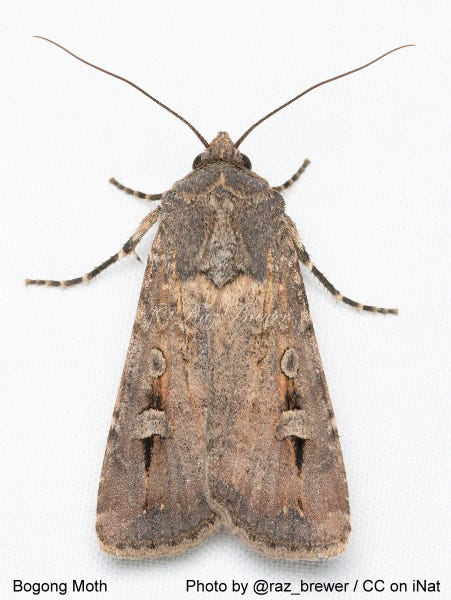
There’s a current study being undertaken in Australia to track the migration route of the Bogong Moth, Agrotis infusa, an endangered species that’s suffered recent population crashes due to warming climate. These moths are known to spend the hot summer in large colonies in the cool caves of the Australian Alps, then migrate back to their breeding grounds in the fall as the weather starts to cool. The researchers plan to capture 10,000 individuals at their winter sites and tag them with similar individually-numbered paper stickers to those used for Monarch tagging programs. Then they’re relying on a citizen science network (even offering to loan “bug lanterns” to people who want to participate) to watch for these tagged moths and report any they find. A 0.2% observation rate, the percent seen in the mark-recapture study of Ipsilon Dart (incidentally in the same genus), would yield 20 data points. Even a 1% recovery rate would only produce 100. The hope is that even a small number of sightings will return data on the route these endangered moths take between their summer and winter sites, which will help inform conservation efforts.
Such mark-and-release programs are not particularly common because of the amount of effort required to generate even a tiny bit of useful data. It’s only when they reach scale that the number of recaptures or sightings grows to a substantial number. The Monarch Watch tagging program has 7418 Canada/USA tag reports over the eight seasons from 2017 to 2024. (Interestingly, from that same period there were only 4224 tag reports from the winter grounds in Mexico.) But the number of tags placed on butterflies each year is massive, to generate this recapture volume - over 100,000 individuals tagged in an average year, which means upwards of 3/4 million Monarchs during that same eight year period. Monarch Watch reports a recovery rate of about 1.5%.
Still… imagine what we could learn if we employed a similar citizen science-driven initiative to study moths’ movements. The research “infrastructure” is already there - thousands of moth-ers running their lights every night, attracting moths that can then be tagged, and that will hopefully also include the rare recapture. We could learn so much about who migrates and who doesn’t, where they go and when.

This was a fascinating read, thank you! I didn't know about isotope analysis at all - it's amazing what we can do to better understand the lives of animals. I too hope that one day there will be more studies of moth migration.
Regarding Monarchs, though, I live in Toronto and was quite surprised to spot at least five Monarchs in High Park's grasslands just this past Friday the 22nd. It seemed early for them. I'll add my sighting on iNat to help with that migration map.
Thanks for all your wonderful work on these amazing beings!